Thursday, July 17, 2008

And Now, for Something Completely Different...


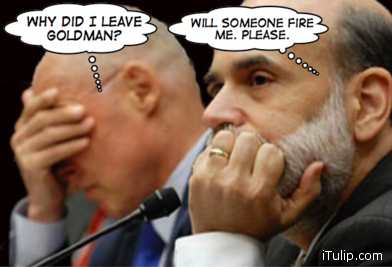
(Photo of Treasury Secretary Hank Paulson (L) and Federal Reserve Chairman Ben Bernanke (R) from itulip.com)


(More fun from itulip. I'm not a fan of rapacious speculators, but it's a fun cartoon. And, if that wasn't enough fun, here's more from the same site below.)

Send a JibJab Sendables® eCard Today!

Tuesday, July 15, 2008

07/15/08-Drive to Impeach Advances Today - Needs Your Support. Please Sign the Petition!


(Picture: "1,000 People Spell Out "IMPEACH!" in Pelosi's District " from 'Impeach for Peace'.)

Support Kucinich - Sign the Online Impeachment Petition!

Click here to read or sign.

Kucinich May Get Hearing On Impeachment Resolution

The House Judiciary Committee may let anti-war Rep. Dennis J. Kucinich present his case for impeaching President Bush before the August recess, the panel’s chairman said Monday.

Chairman John Conyers Jr. , D-Mich., said Judiciary will take a broad look at the behavior of the Bush administration, and Kucinich can lay out his arguments as part of that as-yet unscheduled hearing.

Kucinich, D-Ohio, intends to formally offer a resolution on Tuesday that accuses Bush of lying to Congress in order to get approval to invade Iraq.

Thursday, July 10, 2008

Health Care News


(Photo of sailboat in the Lake Washington Ship Canal, Seattle, by me.)

I wanted to highlight some recent health care news for my colleagues (not just nurses).  

Group calls for zero tolerance of doctor bullies 

By CARLA K. JOHNSON, Associated Press Writer
Wed Jul 9

Bullying doctors can make nurses afraid to question their performance, resulting in medical errors, according to a hospital group that announced new requirements for cracking down on intimidating behavior.

Outbursts and condescending language threaten patient safety and increase the cost of care, according to a safety alert issued Wednesday by the Joint Commission, an independent organization that accredits most of the nation's hospitals.

Hospitals will be required by next year to have codes of conduct and processes for dealing with inappropriate behavior by staff, said the group's president, Dr. Mark Chassin. Hospitals without such systems risk losing their accreditation, he said.

Powerful doctors mean money for hospitals because they choose where to admit their patients, but they "should not be left off the hook," said Dr. Peter Angood, vice president of the group, which is based in suburban Chicago...

Hostile Hospital Behavior Rapped

July 9, 2008 -- Intimidating and disruptive behaviors from health care workers are "not rare" in hospitals and other health care organizations, and a U.S. hospital accreditation group today put that behavior in permanent time-out.

"By allowing this type of behavior to go unchecked, health care organizations are tacitly condoning it," Mark Chassin, MD, MPP, MPH, president of The Joint Commission, said at a news conference. "Enough is enough."

The Joint Commission's new standards -- which go into effect on Jan. 1, 2009 -- require hospitals and other health care organizations to develop a code of conduct and a system to deal with bad behaviors ranging from being uncooperative to being verbally or physically abusive -- even if the offender is a big shot doctor or an administrator.

BULLYING BEHAVIORS

Acts that interfere with patient care
Medical intimidation can encompass behaviors that range from verbal insults to physical assault, say researchers who've studied the problem for years. The broad category includes the following specific behaviors, outlined in a medical safety journal.
— Profane or disrespectful language
— Demeaning behavior, such as name-calling
— Sexual comments or innuendo
— Inappropriate touching, sexual or otherwise
— Racial or ethnic jokes
— Outbursts of anger
— Throwing instruments, charts or other objects
— Criticizing other caregivers in front of patients or other staff
— Comments that undermine a patient's trust in other caregivers or the hospital
— Comments that undermine a caregiver's self-confidence in caring for patients
— Failure to adequately address safety concerns or patient care needs expressed by another caregiver
— Intimidating behavior that suppresses input by other members of the healthcare team
— Deliberate failure to adhere to organizational policies without evidence to support an alternative
— Retaliation against any member of the health care team who has reported a violation to the code of conduct or who has participated in an investigation of an incident

Cipro, similar antibiotics to get 'black box' warning

Posted July 8, 2008

Washington (AP) _ Drug safety officials are calling for an urgent safety warning for Cipro and similar antibiotics. 

The Food and Drug Administration is ordering the "black box" wording due to evidence the drugs may lead to tendon ruptures. They say the ruptures could result in serious injury that can leave patients incapacitated and in need of extensive 
surgery. 

The makers of the potent class of antibacterials will also need to develop new literature for patients to emphasize the risks. The two leading drugs covered by the warning are Cipro, made by Bayer, and Levaquin, which is made by Ortho-McNeil. 

Tendon ruptures normally result from sports injuries. The link to treatment with the antibiotics is highly unusual, and scientists still don't fully understand why it happens. 

FDA officials said they had received several hundred reports of tendon ruptures. However, FDA officials say many of the serious injuries could be preventable if patients stop taking the drug at the first sign of pain or swelling in a tendon, call a doctor, and switch to another antibiotic. For more information, please visit

http://www.fda.gov/cder/drug/InfoSheets/HCP/fluoroquinolonesHCP.htm


AMA to apologize to black doctors for racism

"The American Medical Association is issuing a formal apology for more than a century of discriminatory policies that excluded blacks from participating in a group long considered the voice of U.S. doctors...

...It comes more than 40 years after AMA delegates denounced policies at state and local medical societies dating to the 1800s that barred blacks. For decades, AMA delegates resisted efforts to get them to speak out forcefully against discrimination or to condemn the smaller medical groups that historically have had a big role in shaping AMA policy...

..."It is true that what the AMA did historically was awful," said Dr. Otis Brawley, the American Cancer Society's chief medical officer. "There were AMA local chapters that actually had rules against black members well into the late 1960s, and policies that made blacks not feel comfortable well into the 1980s."...

On the Net:

AMA: http://www.ama-assn.org

NMA: http://www.nmanet.org

Monday, July 7, 2008

The Discreet Anguish of the Bourgeoisie.


(Photo of restroom wall in Fremont Coffee by me.)

"Blogging: the opiate of the cyber-petit bourgeoisie." - kersplebedeb

1. It's not our fault - at least not entirely.

America's middle-class collapse

"...what makes this coming decline in economic security different from the one visited upon American families in the 1970s, for example, is that we are much less well positioned to withstand the financial buffering. The work of Harvard law professor Elizabeth Warren indicates there is a coming collapse of the middle class and she can prove it with a raft of scary statistics and charts. 

Warren says we are moving toward a two-class rather than a three-class society, where there is a somewhat larger upper class made up of the financially comfortable and then there is the rest of America, people who are "constantly living on the edge of a cliff." These are families who might appear to earn a decent income but they enjoy none of the financial security that we normally associate with middle-class status. 

Warren compares the median American family of 1970 with that of 2003. She unpacks why our savings rate has dropped to zero from a rather healthy 11 percent of take-home pay in 1970, even as the family added Mom as a breadwinner. 

Typically, blame for this lands on families themselves. They're spending themselves into penury by buying designer clothes for their kids and indulging in $4 lattes, say social commentators. 

Not so, Warren counters. She says that Americans are actually spending far less in inflation-adjusted dollars for things like clothes and food, including eating out, than they did in 1970. What has substantially changed, Warren reports, is the cost of big-ticket, fixed expenses. So that even though the income of the median two-parent, two-child family is higher because both parents are employed, the family has less income available to shore itself up against a rough patch. 

Housing costs for a medium-size house (which has gotten modestly bigger since 1970 by adding either a second bathroom or a third bedroom but not both) have increased 76 percent. 

Health insurance costs are up 74 percent. 

Also up sharply are taxes (due to the second income), child care and car-related expenses. Americans keep a car more than two years longer than they did 30 years ago but they now need two cars to get to two jobs. 

These big, inflexible expenses cost the median family three-fourths of its two-earner income. In 1970 they cost half of the single breadwinner's. We now live in a country where there is no financial margin for most families to fall back on in case someone gets sick or a job is lost. Life is far riskier. 

Then add on an energy crisis and you can almost hear the foundation cracking..."

2. Understanding and dealing with the effects;

Head fake
How Prozac sent the science of depression in the wrong direction

"...There's only one problem with this theory of depression: it's almost certainly wrong, or at the very least woefully incomplete. Experiments have since shown that lowering people's serotonin levels does not make them depressed, nor does it does not make them depressed, nor does it worsen their symptoms if they are already depressed.

In recent years, scientists have developed a novel theory of what falters in the depressed brain. Instead of seeing the disease as the result of a chemical imbalance, these researchers argue that the brain's cells are shrinking and dying. This theory has gained momentum in the past few months, with the publication of several high profile scientific papers. The effectiveness of Prozac, these scientists say, has little to do with the amount of serotonin in the brain. Rather, the drug works because it helps heal our neurons, allowing them to grow and thrive again.

In this sense, Prozac is simply a bottled version of other activities that have a similar effect, such as physical exercise. They aren't happy pills, but healing pills.

These discoveries are causing scientists to fundamentally reimagine depression. While the mental illness is often defined in terms of its emotional symptoms - this led a generation of researchers to search for the chemicals, like serotonin, that might trigger such distorted moods - researchers are now focusing on more systematic changes in the depressed brain.

"The best way to think about depression is as a mild neurodegenerative disorder," says Ronald Duman, a professor of psychiatry and pharmacology at Yale. "Your brain cells atrophy, just like in other diseases [such as Alzheimer's and Parkinson's]. The only difference with depression is that it's reversible. The brain can recover."...

...One of the first cracks in the chemical hypothesis of depression came from a phenomenon known as the "Prozac lag." Antidepressants increase the amount of serotonin in the brain within hours, but the beneficial effects are not usually felt for weeks.

This led neuroscientists to wonder if something besides serotonin might be responsible. Duman, for instance, began to study a class of proteins known as trophic factors, which help neurons grow and survive. Trophe is Greek for nourishment; what sunlight and water do for trees, trophic factors do for brain cells. Numerous studies had shown that chronic stress damages the brain by suppressing the release of trophic factors. In a series of influential papers published earlier this decade, Duman demonstrated that the same destructive hallmark is seen in depression, so that our neurons are deprived of what they need.

"The mental illness occurs when these stress mechanisms in the brain spiral out of control," he says.

Once that happens, the brain begins to shut itself down, suppressing all but the most essential upkeep. Not only do neurons stop growing, but the brain seems to stop creating new cells. .."

Wednesday, July 2, 2008

Missing Connecticut


Here I am, in a Seattle neighborhood that actually has the balls to bill itself as "The Center of the Universe". The weather is perfect. I could literally walk to half a dozen clubs with really good live music - not to mention a decent used book store, a food co-op, and even a vegan restaurant. Cars actually stop to let me cross the street (how weird is that?). I have yet to be bitten by a mosquito. No one worries about Lyme Disease, or West Nile Virus. There is almost no trash on the streets.

I'm sure that it's hotter, more humid, and smoggier in CT.  The mosquitoes are out, at dusk, carrying West Nile Virus, and the threat of encephalitis.  The ozone level is way up, and asthmatics are crowding the ER's. My own breathing would be affected - which is no small thing, on a day to day basis. Kids are getting shot in New Haven. Drivers are dying, practically daily, on I-95. The music scene has been on life support for years. Nothing to do but hide in an air-conditioned room - and try not to think about the bill for the a/c.

Why do I miss this place?

I don't know, but I do. And I love this video. Especially that opening zoooom up the highway, with the music blaring, and then the guy saying, "This is how we f&*%ing do it in Bridgeport. Welcome home." I keep looping that part, obsessively. But, I think the whole video is really well done.

It makes me happy to know that these kids are out there, creating art, creating movies, balancing out the bad karma from the snobs and hedge fund managers (aka economic terrorists) in Greenwich. And it reminds me of that indefinable spirit that I like about the place.

Tuesday, June 24, 2008

In Which I Finally Run Away and Join the Circus


(Photo of me by a fellow marcher. For more photos of the Fremont Solstice Parade, check out my photostream.)

Yes, they were hiring circus freaks (harharhar) ... or overweight fake gypsies, or something. Anyway, I have been volunteering for, and subsequently marched in the Fremont Solstice Parade in Seattle this past weekend.

Fremont is a hippie/artsy neighborhood, and the parade reflects that. Indeed, it is the very height of the social season here. Rules include no words - just pictures, no motorized vehicles, and no live animals except service animals. Nudity, however, is very much allowed, and a handful of my photos are NSFW.

Despite that, it is very much a family affair, with plenty of children in the parade and the audience - all seemingly unharmed. In fact, I marched at the head of the parade, in a mixed group of adults and children waving tie-dyed streamers from bamboo stalks - and we were immediately after the topless banner-bearer girls, who were immediately after the unofficial contingent of naked, body-painted bicyclists.

This was probably a good thing, as I had been instructed that our job was to "create good juju" - i.e., get people psyched up for the rest of the parade. Between the distractions in front, and the acrobats cart-wheeling behind us, hopefully no one noticed that I spent most of the parade dealing with my own personal wardrobe malfunction. Namely, my bamboo pole kept breaking, as I frantically whirled it like an Olympic "floor exercise" hopeful, taking it down, chunk by chunk, from about 20 feet to about 3 feet.  I consoled myself that at least the waste was biodegradeable ( I think not recycling would be counted as a mortal, as opposed to venial, sin, in this neighborhood), but this did nothing to alleviate my anxiety that my attempts at discreet disposal would either impale a bystander, or cause a tragic cartwheeling accident.

Well, I didn't kill anybody - not that I noticed, anyway.  The bamboo, BTW, had actually been cut down with a chainsaw from somebody's garden by a volunteer. (I asked, because I had noticed how impossible it was to break the bamboo when I was helping to move it, and was actually trying to break it into more manageable pieces. Who knew that bamboo molecules go through a phase change in the presence of large groups of costumed hippies that make them much more susceptible to shearing forces?) Most of the pieces were so big that the parade organizers had resorted to storing them on the flat roof of the parade headquarters building, while they awaited their transformation from camouflage to art. The scarf, beads, etc., were supplied by a fellow participant to jazz up my meager travel wardrobe. In fact, I was also wearing a donated sarong made out of Kente cloth dyed by African schoolchildren that my benefactor picked up during a trip to Ghana. But, at some point, that turned into wardrobe malfunction #2, exposing the bright purple scrub pants that I had worn, in an attempt to comply with the exhortation to wear bright colors.

What can I say ... it's a tough job, but somebody's gotta do it.

Anyway, y'all check out my photos. I just uploaded a ton of them, and they're mostly pretty fun, if I do say so myself.

Friday, June 20, 2008

"Take Away Books That Nerds Don't Deserve"


As a nerdette, bookworm, and nerdcore fan, I am loving this video!!!

"See a nerd reading a book, whatcha gonna do??
 Whomp that nerd!"